Gerry and Stella’s Amsterdam trip
Midwinter BreakGerry and Stella’s Amsterdam trip is a four-day midwinter holiday that exposes the distance beneath a retired couple’s familiar routines. Sightseeing and a change of scene become a test of what remains of their marriage: Stella wants a life shaped more by faith and service, while Gerry’s forgetfulness and concealed drinking make her doubt that they can continue as they are. Their tentative closing exchange offers neither a cure nor a clean break, but a condition on which their shared life might continue.
A holiday becomes a reckoning
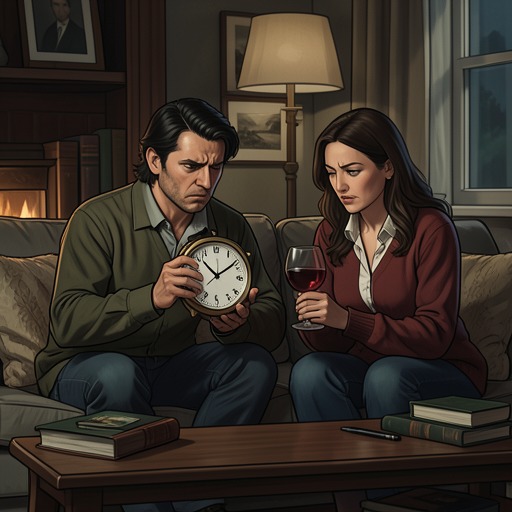
Gerry and Stella Gilmore fly from Scotland to Amsterdam for a long weekend intended to refresh the senses and give them time to take stock. At first, the trip appears to extend the ease and familiarity of their life together. But its close quarters and unhurried days give Stella room to voice what ordinary routines have allowed to remain unsettled. She tells Gerry she is tired of living as they do and wants to live more devoutly, through prayer and charity. Her faith is not a settled agreement between them: Gerry does not share it, and she feels that he persistently undermines it.
Stella’s concern is not simply about belief. She describes feeling aimless and without a role, with their only grandchild living in Canada and no expectation of more grandchildren. She wants to do something better with the time left to her, rather than spend it watching Gerry drink. When she asks whether she appears in his storyboard of life, his answer is effectively no. The exchange turns an abstract difference in outlook into a personal measure of their separation: she is considering a future whose shape no longer assumes him at its centre.
The city and Stella’s possible vocation
On an early walk, Stella finds a passage leading into a quiet quadrangle at the Amsterdam Begijnhof. She describes houses gathered around green space and an old church, contrasting the sheltered setting with the busy city outside. The church is closed when she arrives, but the place stays with her. She wants to learn about the woman associated with it and considers whether its female community might offer a way to live differently.
The possibility gives concrete form to her wish for a more purposeful life. Yet the news is discouraging: women may still live there, but the waiting list is perhaps five years or longer, and applicants must be between thirty and sixty-five, able to live alone, and able to afford it. Stella is too old to qualify. The rules make her hope collide with an institutional threshold; a place that seemed to promise an alternative cannot receive her on the terms she imagined. Her disappointment is not only about losing a particular residence. It forces her to consider that, even if she cannot join this community, she may still leave the life she shares with Gerry and live independently.
Faith, memory, and the marriage
The trip’s present-day conversations are shadowed by memories of religious practice and of the couple’s life in Ireland. Gerry recalls a Christmas Mass from a few weeks earlier, when Stella served as a Eucharistic minister alongside Sister Francis. Watching her distribute communion had made him see her as someone he did not fully know, and as older than he had allowed himself to notice. The recollection complicates his distance from her faith: he may not believe as she does, but he recognizes the force and dignity of her religious role.
Another night, he sees Stella praying beside the bed. Her routine moves through family members, gives thanks for her survival, and extends to refugees and people fleeing war. Prayer is both intimate and practiced: a way of remembering those she loves and of attending, however briefly, to suffering beyond the family. Gerry stops himself from making a joke. The pause matters because it marks a moment when he recognizes a private part of Stella’s life instead of dismissing it.
The couple’s past and their advancing age also make the holiday a reckoning with time. After learning she is too old for the Begijnhof, Stella cries and sees red marks on her thighs where her elbows pressed as she wept. The small physical traces turn an inward crisis into something visible. She thinks of childhood records and the card and wrist tag kept from her son’s birth, and is startled by how a single thought can carry her across six decades. She fears the loss of memory that she has witnessed in her mother and grandmother, while noticing that Gerry, too, forgets words, conversations, meals, and plans. His lapses are not abstract: she has had to remind him about dinners and events, sometimes finding him absorbed in his books when they should already be leaving.
Drinking, dependence, and a conditional return
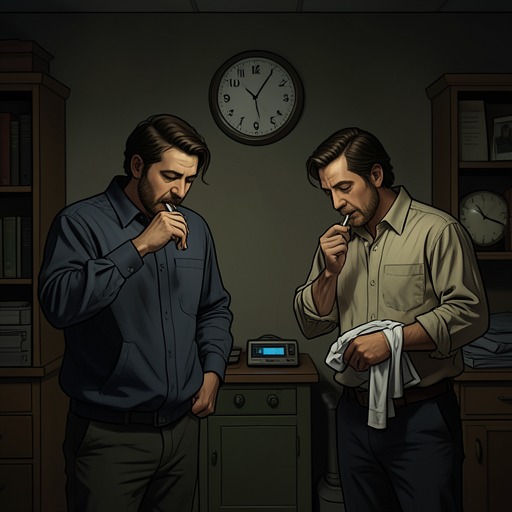
Gerry’s drinking repeatedly cuts across the trip’s attempts at intimacy. Stella says plainly that she does not want to spend her remaining years watching him drink. Yet after she falls asleep, he retrieves a half-bottle he has hidden in his jacket and takes it into the bathroom, covering the sound of its cap with a cough. The secrecy gives the marital conflict a material, immediate form: while Stella is trying to describe a possible future, Gerry is concealing the habit that helps make that future feel necessary to her.
At the end of the break, the alternative of an all-female religious community has closed. Stella nevertheless imagines that she could live on her own, perhaps with the couple selling their tenement flat and buying two smaller flats. Even as she pictures separation, she catches herself organizing Gerry’s life—thinking about his books, meals, and where he might live. Her instinct to care for him persists inside the plan to leave him, revealing how difficult it is to disentangle affection from the labor of looking after him.
The ending remains conditional. Stella tells Gerry that if he is as good as his word about giving up drinking, their home may not have to be sold. He touches her arm, and after a silence he repeats the assurance that all shall be well. The phrase does not settle whether he will keep his promise or whether the marriage can recover. Instead, the trip ends with a narrow possibility: remaining together depends on a change in the behavior that has helped drive Stella toward another life.